
Why Councils Need Better Mobile Coverage Evidence
Why local mobile coverage issues need more than anecdotal evidence
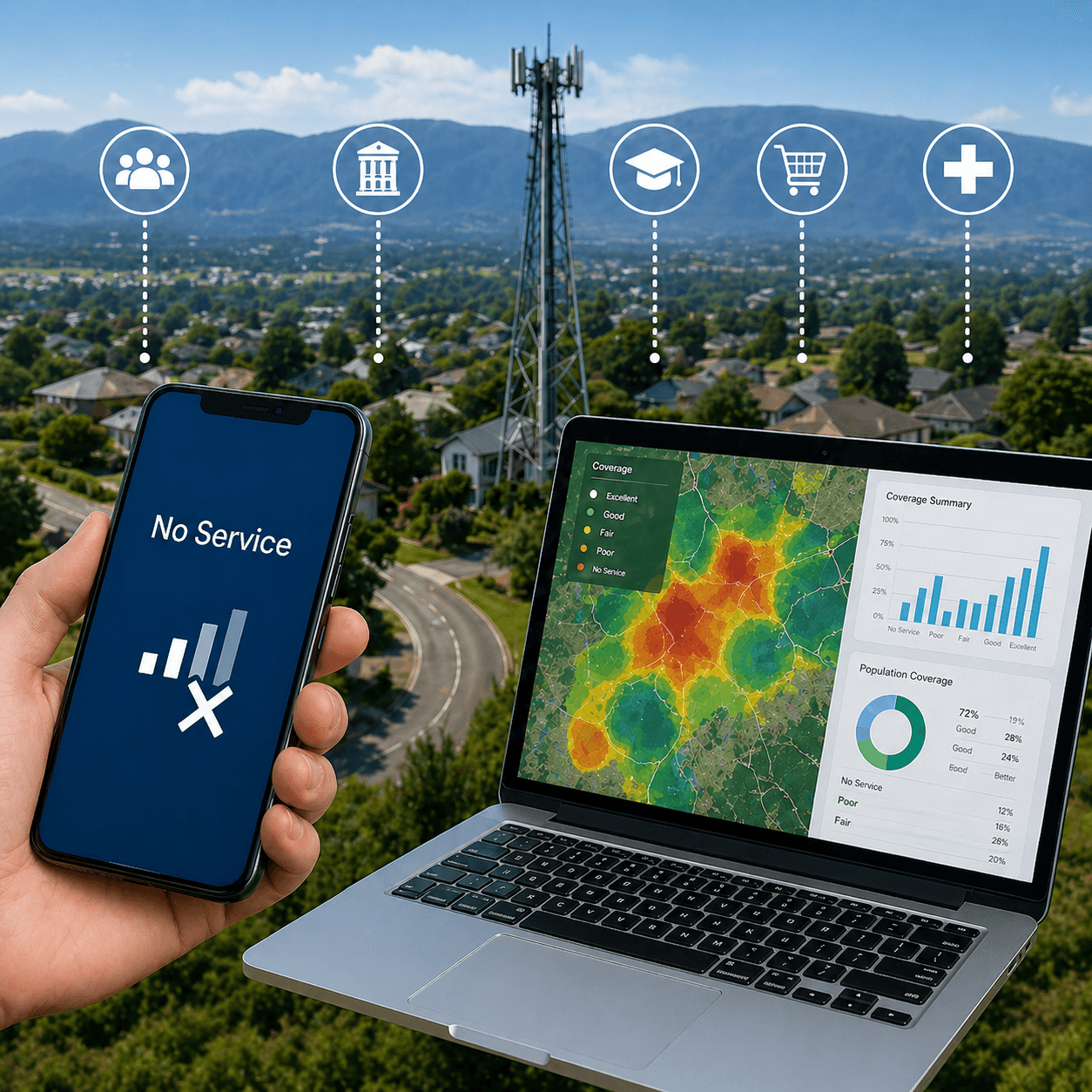
Most councils we speak with already know they have mobile coverage problems. The question they struggle with is what to do about it.
Coverage concerns tend to arrive through a mix of channels — resident emails, councillor enquiries, business complaints, social media, the occasional letter from a community group. Each of these tells you something. None of them tells you enough on its own. They show that a problem exists, but rarely where it begins or ends, which carrier is involved, whether it is an outdoor signal issue or an in-building one, whether congestion is a factor, or whether the experience worsens along a particular road or at particular times of day.
Without that detail, conversations with mobile network operators are difficult. So are submissions to state and federal funding programs, planning negotiations with developers, and discussions with neighbouring councils about shared infrastructure. The council ends up advocating from anecdote while the operator responds from modelled coverage maps. The two views rarely meet in the middle.
Structured local evidence is what closes that gap. It does not require a council to take on the role of a telecommunications carrier. It requires a defensible record of what residents actually experience: where signal is weak, which operators are affected, what type of service is failing, and how that maps against the places people live, work and travel.
That kind of evidence allows a council to identify blackspots and weak-service areas with reasonable precision, compare carriers on the same terms, separate residential issues from growth-corridor issues from transport-corridor issues, and prioritise based on measured impact rather than complaint volume. It also strengthens advocacy. A submission to the Mobile Black Spot Program, a planning panel hearing or a meeting with an operator's government affairs team carries more weight when the council brings field measurements rather than a tally of resident complaints.
Coverage maps published by operators are useful as a starting point, but they are propagation models. They estimate where signal should reach. They do not show what happens to that signal indoors, around tall buildings, in a road cutting, during peak load, or on a particular handset. Complaint data captures only the residents who felt motivated enough to report — usually a fraction of those affected.
What sits between the model and the complaint is field evidence. For fast-growing LGAs, regional towns and industrial precincts, that evidence is increasingly part of how councils make the case for better connectivity. Mobile coverage is no longer a convenience question. It connects to local productivity, public safety, accessibility and the digital inclusion of residents who have nowhere else to turn.