
Why Complaint Data Alone Is Not Enough
Complaints identify concern, but they rarely define the full network problem
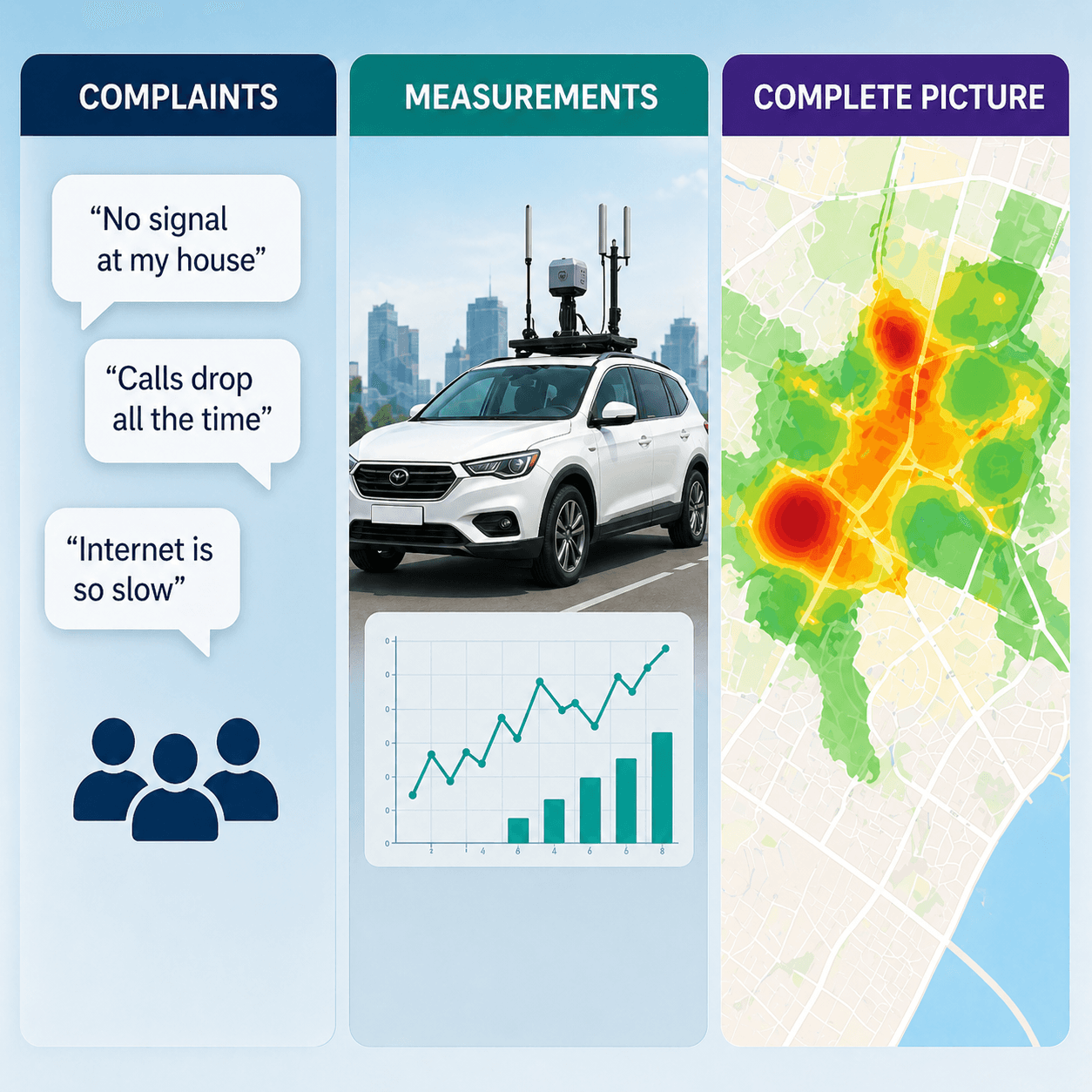
Resident complaints matter. They are often the first signal a council receives that something is wrong with mobile coverage in a particular area, and they give residents and businesses a legitimate channel to be heard.
But complaints, on their own, will not tell a council what it actually needs to know to fix the problem.
Complaints are unevenly distributed. Some residents will email three times in a week. Others will experience the same dropouts every day for years and never raise it — either because they assume nothing will change, or because they have already switched provider, or because they don't know where to direct the issue. Areas that look quiet in the customer-relations system are not necessarily areas where the network is performing well. They may simply be areas where people have given up.
Complaints also tend to be light on technical detail, which is no fault of the residents reporting them. "No reception", "calls drop", "internet too slow", "doesn't work in the kitchen" — these are how the experience is described, not how the underlying problem can be diagnosed. The same description can map to weak outdoor signal, poor in-building penetration, an uplink limitation, congestion at a particular cell, a handover failure, latency on the backhaul, or a localised fault that has been ongoing for weeks. Without measurement, there is no way to tell which.
Complaint volume is also a poor basis for comparing operators. The carrier with the largest customer base in a suburb will usually generate the most complaints, even if a smaller carrier is performing worse on every technical measure. A council acting purely on complaint volume can end up advocating with the wrong operator, or about the wrong issue.
None of this means complaints should be set aside. Used well, they are one of the most valuable inputs a council has. They identify priority areas to investigate. They surface user impact in language that resonates with elected members and the public. They help frame why the work matters.
The stronger approach is to treat complaints as one layer in a broader picture. Complaint locations point to where to test. Targeted survey responses describe how the issue is affecting daily life — work, study, business, safety, access to services. Field measurements confirm whether the problem is technically present, where it begins and ends, and which carriers are involved. Geospatial analysis sets all of that against the places people live, work and travel through. The reporting then turns the combined evidence into something that can support a decision.
Complaints start the conversation. Structured evidence is what moves it forward — into operator engagement, planning negotiations, funding submissions and the kind of advocacy that produces results.