
What Route-Based Telecom Measurement Can Reveal
Why measuring roads, corridors and local movement patterns matters
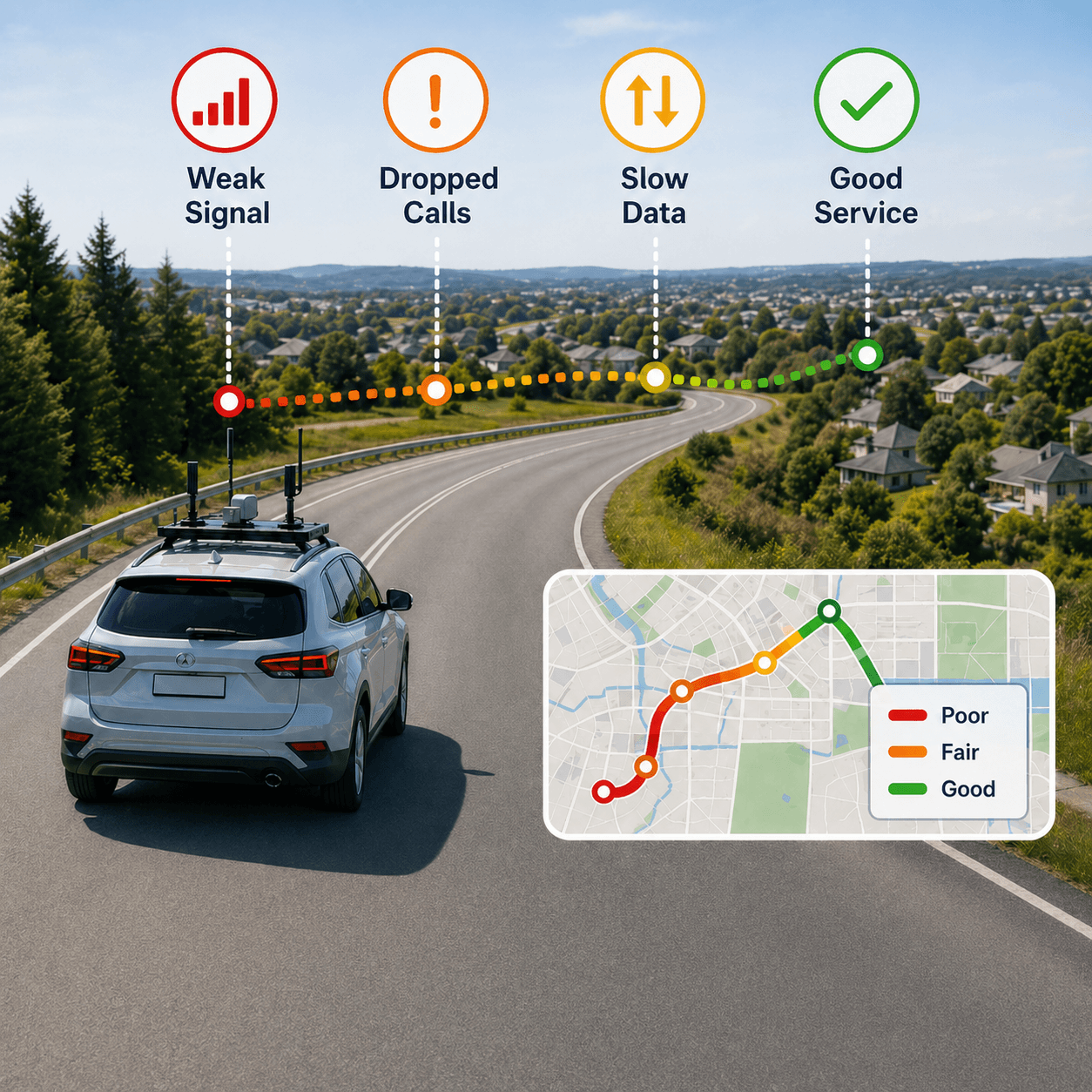
Mobile networks are experienced in motion. People use them while driving the children to school, commuting between towns, walking through the local centre, working out of a ute, responding to an emergency, or making the long drive home through patches of poor reception that everyone in the area knows about but no one has ever quantified.
This is what route-based measurement is for.
A static check at a single point tells you what the service is like at that point. It does not tell you what happens along the route between points. Many of the most consistent mobile issues councils hear about are mobility issues — call dropouts at a particular bend in the road, throughput collapsing as the car climbs out of a valley, the network falling back from 5G to 4G to 3G across a stretch of highway, a handover that consistently fails between two cells servicing a school catchment.
A drive test captures all of that. It records signal strength, signal quality, serving technology, latency and throughput as the device moves, time-stamped and geolocated. When the same route is tested across multiple operators, the results show whether a problem is carrier-specific or affecting everyone — a distinction that changes how the issue should be raised and with whom.
The routes worth testing depend on the council's priorities, but they tend to fall into a familiar set: growth suburbs and new estates, where modelled coverage is often based on assumptions that have changed since approval; the connector roads between villages, towns and employment centres; emergency service access routes; public transport corridors; tourism and regional highways; industrial and logistics precincts; and the routes residents themselves keep raising.
Route-based outputs work best when they are visual. A colour-coded map along the path is more useful to councillors and community stakeholders than a table of dB values. Summary tables can sit alongside, comparing carriers section by section. The technical logs remain available for engineers and operator engagement.
Drive testing does not replace static or in-building measurement, and it does not capture every kind of mobile issue. It complements them. But for understanding the connectivity people actually experience while moving through their LGA, it remains one of the most practical tools available.
It also changes how the conversation can be framed. Instead of "coverage is poor in our area", the council can say: service quality drops across this 4-kilometre section of the connector road, affects this carrier in both directions of travel, and falls below usable thresholds during weekday peak. That level of specificity is what operators, regulators and funding bodies need before they will engage seriously.