
Reading Mobile Coverage Through a Service-Equity Lens
Why coverage assessments are more useful when overlaid with population and land-use data
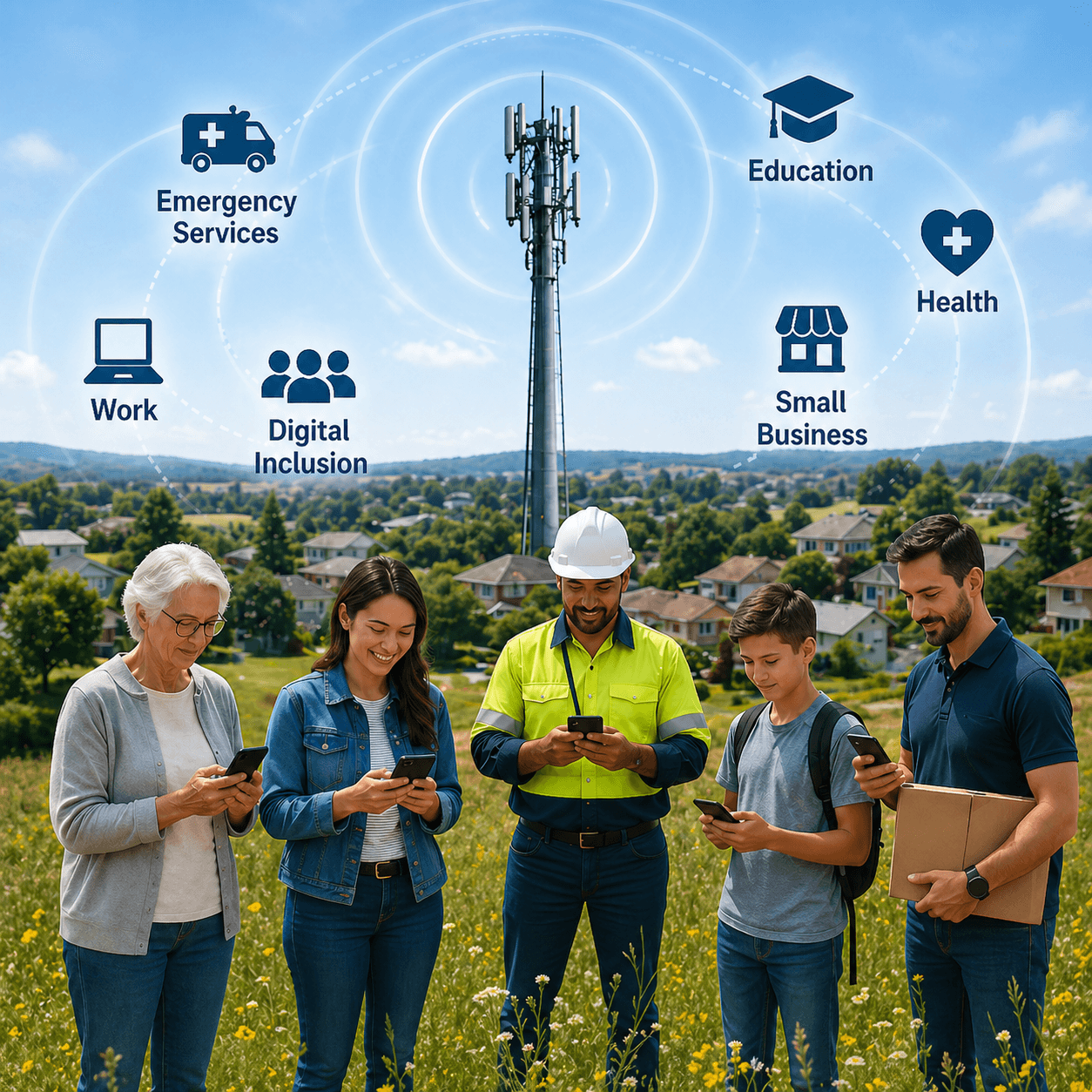
Most mobile coverage analysis focuses on the network — towers, signal levels, frequency bands, throughput, latency, coverage maps. That is the right place to start. But coverage data becomes more useful for council decision-making when it is read alongside information about who is affected and how.
The same level of network performance can have different practical implications depending on the population it sits over. A weak-service area in a suburb where most households have fixed broadband, Wi-Fi calling and access to multiple carriers is a different problem from a weak-service area in a part of the LGA with a higher proportion of older residents living alone, renters without home internet, small businesses dependent on mobile EFTPOS and Tap-and-Go, or shift workers travelling at hours when the network is least supported. The technical reading of the two locations may be similar; the operational reading is not.
This is the basis of a service-equity overlay. It does not change what is measured. It changes how the measurements are interpreted alongside other datasets the council already holds: population and demographic profiles, land use, location of schools, health facilities and aged-care, public transport routes, emergency service access roads, and growth-area planning. The overlay highlights where measured coverage gaps coincide with locations or populations that have fewer alternatives when mobile service falls short.
There are practical reasons councils find this useful. It supports prioritisation when the evidence base is larger than the resources available to act on it. It helps frame submissions to programs such as the Mobile Black Spot Program and the Regional Connectivity Program, where public-interest considerations are part of the assessment criteria. It informs internal discussions about where to focus operator engagement first. And it gives elected members a clearer picture of how connectivity issues map against the communities they represent.
Mobile connectivity sits in a different regulatory category from water, roads, electricity or public transport, and councils do not have the same levers to influence its delivery. But mobile networks are increasingly the means by which residents access services in those other categories — telehealth, online government transactions, public transport information, banking, education. That makes the population context relevant to how coverage data is read, even where it does not change the underlying technical findings.
For councils and public agencies, the value of the overlay is mainly analytical. It helps move from "where does the network underperform" to "where does network underperformance intersect with the places and populations most affected by it" — a question that is generally more useful when prioritising next steps.