
Modelled Coverage Versus Real-World Mobile Experience
Why predicted mobile coverage does not always match what people experience
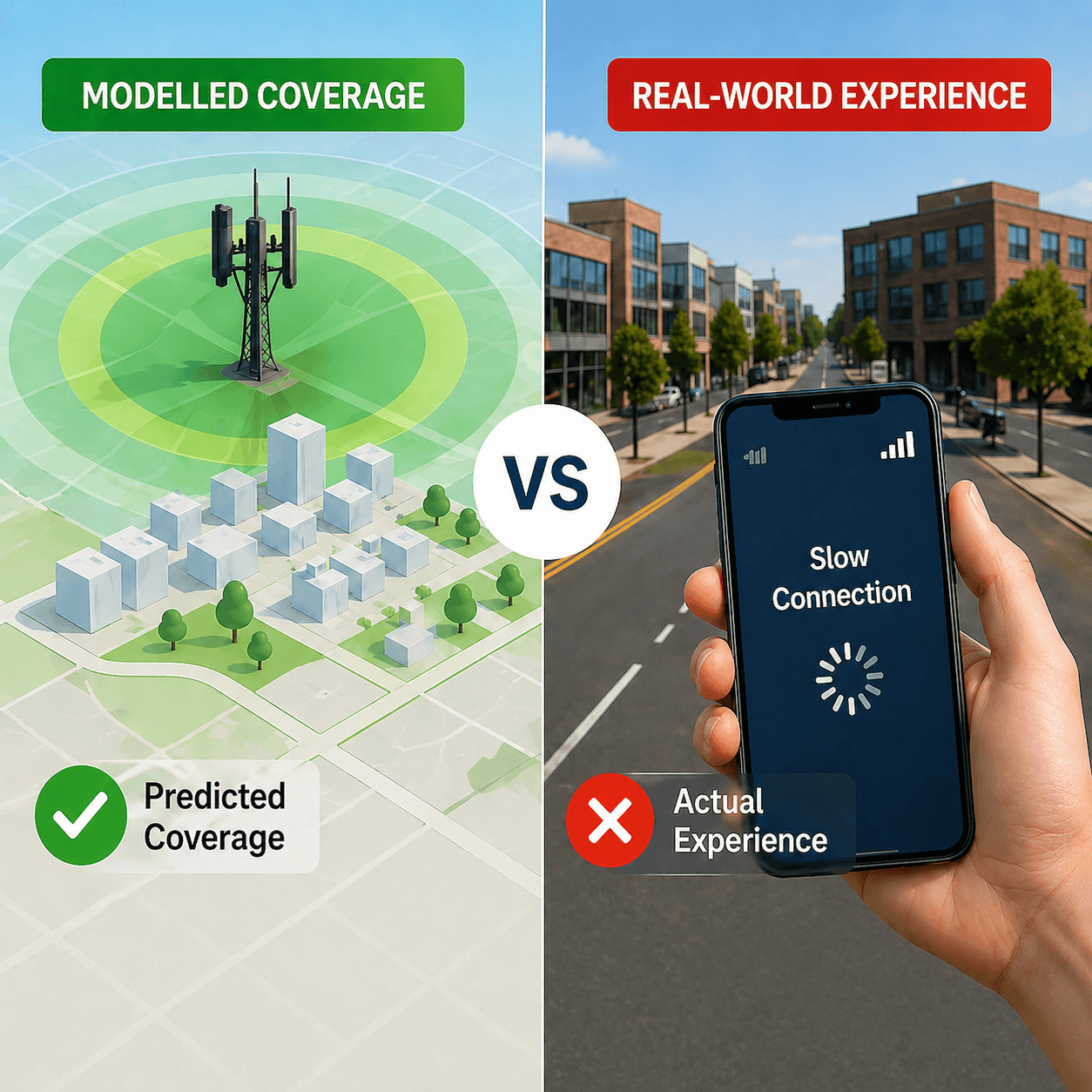
Operator coverage maps are propagation models. They estimate where a signal should reach, based on tower locations, antenna patterns, frequency bands, terrain and a set of planning assumptions. They are useful — operators rely on them to design networks, regulators use them to track theoretical service availability, and consumers consult them when choosing a carrier.
But a coverage model is not an experience.
A map can show an area as "covered" while the people living there describe calls dropping in the kitchen, data crawling at school pick-up, payments timing out at the local shop and dead spots along the main road into town. The gap opens up for a few reasons that are worth naming clearly.
The built environment is the most obvious. Modelled coverage rarely accounts well for what happens inside a brick veneer home, a school hall with a metal roof, an aged-care facility set behind tall trees, or a medical centre below ground level. Modern construction materials — particularly low-emissivity (Low-E) glazing and insulated metal cladding — can attenuate mobile signal by 20 dB or more, turning a perfectly serviceable outdoor signal into nothing usable inside.
Signal presence is also not the same as performance. A handset can show full bars while delivering throughput too low for a video call or a Tap-and-Go transaction. Real performance depends on signal strength, signal quality, network load at the cell, available spectrum, backhaul capacity to the site, the device itself and whether the user is moving. None of that shows up on a coverage map.
What counts as "good enough" varies by use. A connection that supports messaging may not support telehealth. A signal that handles navigation may stall on a payment terminal during peak trading hours. The same cell can be acceptable at 10am and unusable at 5pm.
Networks are also dynamic. Maintenance windows, weather events, special events, seasonal population swings (think coastal LGAs in summer) and temporary faults all move performance up and down. A coverage map is a static document; the network it describes is not.
For these reasons, real-world measurement matters. A structured assessment captures what users actually experience across selected routes, suburbs, public facilities and priority sites — recording signal strength (RSRP), signal quality (RSRQ and SINR), serving technology, latency, throughput and test success rates. Combined with geospatial analysis, that data can show where modelled expectations hold up — and where they don't.
The point is not to dismiss operator coverage maps. The point is to complement them. The modelled view answers: where should the network work? The measured view answers a more useful question: where does the network actually work well enough for residents, businesses and essential services? Both are needed if telecommunications decisions are going to stand up to scrutiny.