
How to Design a Local Mobile Assessment Pilot
A practical framework for councils, agencies and local stakeholders
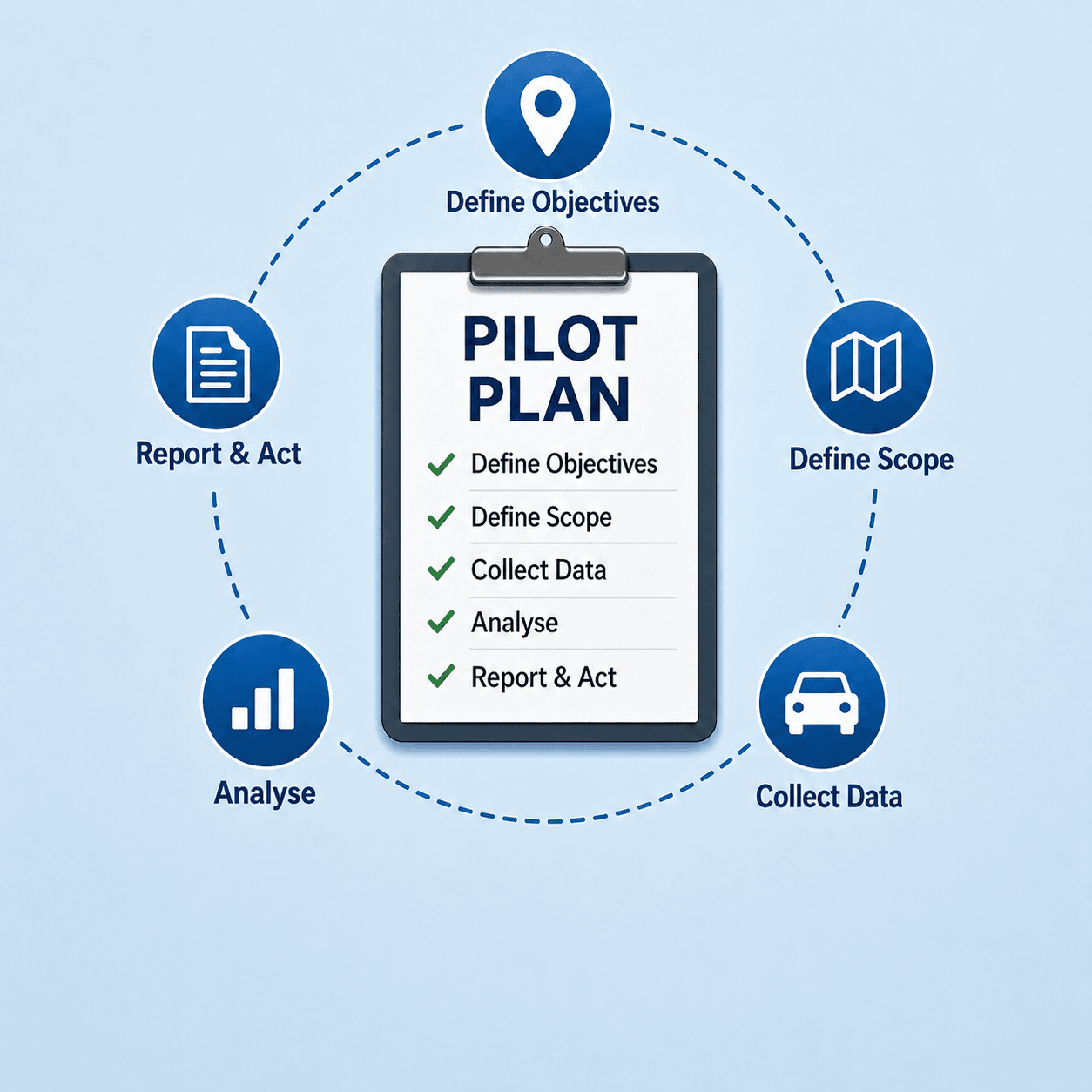
A council does not need to test every road, every suburb and every carrier on its first attempt. A focused pilot, well scoped, will produce more useful evidence than a sprawling assessment that takes a year to deliver.
The point of a pilot is to generate enough credible data to inform a specific decision — and, ideally, to confirm whether a broader program is justified.
Start with the decision. A pilot designed around "we want to understand mobile coverage" will produce something interesting but rarely actionable. A pilot designed around "we want to understand whether the connectivity concerns raised in the last three council meetings reflect a measurable problem, and which operators are involved" will produce something a council can act on. Other useful framings include preparing a Mobile Black Spot Program submission, supporting engagement with a specific operator, informing a developer contribution discussion, or testing whether a new growth area has the connectivity its planned population will need.
Once the decision is clear, scope follows from it. That means choosing a geographic area — specific suburbs, routes, precincts, villages, industrial estates or sites identified through resident complaints; selecting which operators to test (one carrier, all three majors, or a comparative subset); defining the service types of interest, whether voice, data, latency or application-level performance; and choosing a test environment that fits the question — drive testing for routes, walk testing for town centres, static testing for specific buildings, indoor spot checks for community facilities. Time of day matters too. A weekday peak test on a school route will surface different problems than a Sunday morning test of the same path.
The methodology should be transparent. Anyone reading the report should be able to understand what was measured, with what equipment, against what benchmarks and what the limitations are. This becomes important the moment the data is shared with an operator or used in a public submission. Operators will look for reasons to discount findings; a clearly documented method removes the easy ones.
A pilot is also stronger when it draws on more than one source of evidence. Field measurements show what the network is delivering. Resident feedback — through surveys, complaints data or targeted outreach — shows where it matters. Geospatial overlays of schools, health facilities, public transport routes, growth areas and vulnerable populations show who is affected. Each layer fills in something the others can't.
The output needs to work for two audiences at once. Engineers will want the RF and performance data. Councillors, executives and community members need maps, plain-English findings and a short list of next steps. A useful final report typically includes an executive summary, a clear statement of scope and limitations, the measurement methodology, coverage and service-quality maps, an operator comparison, the priority weak-service locations, route-based findings, an interpretation of community impact, recommended actions, and a technical appendix for those who need it.
The right pilot is not the largest one. It is the one that produces evidence the council can use — to engage with operators, support advocacy, inform planning, or justify the next step in a broader assessment.